
Read the Oktibbeha Owner Record
The Tristate appraisal search is the direct public route to the current owner field. It accepts PPIN, PARID, owner, and address. The county's sample card ties the name to parcel identity, location, value, and deed clues. A result can then be checked, not merely repeated.
| Owner Name | The person or entity carried on the current roll |
|---|---|
| Mailing Address | Where assessment and tax notices are sent |
| Situs Address | The physical location assigned to the parcel |
| Parcel Keys | PPIN and PARID used to keep the correct tract in view |
| Last Sale Date | The transfer date displayed on the property card |
| Deed Reference | Book, page, and date clues leading to the recorded instrument |
An owner of record is not always the occupant. A mailing address can sit outside Mississippi. The situs stays in Oktibbeha County, and neither fact is an error. Record the legal description and deed reference too. Names and street addresses change over time. The Oktibbeha appraisal search shows its entry fields. Those fields reach the current roll for any parcel lookup.
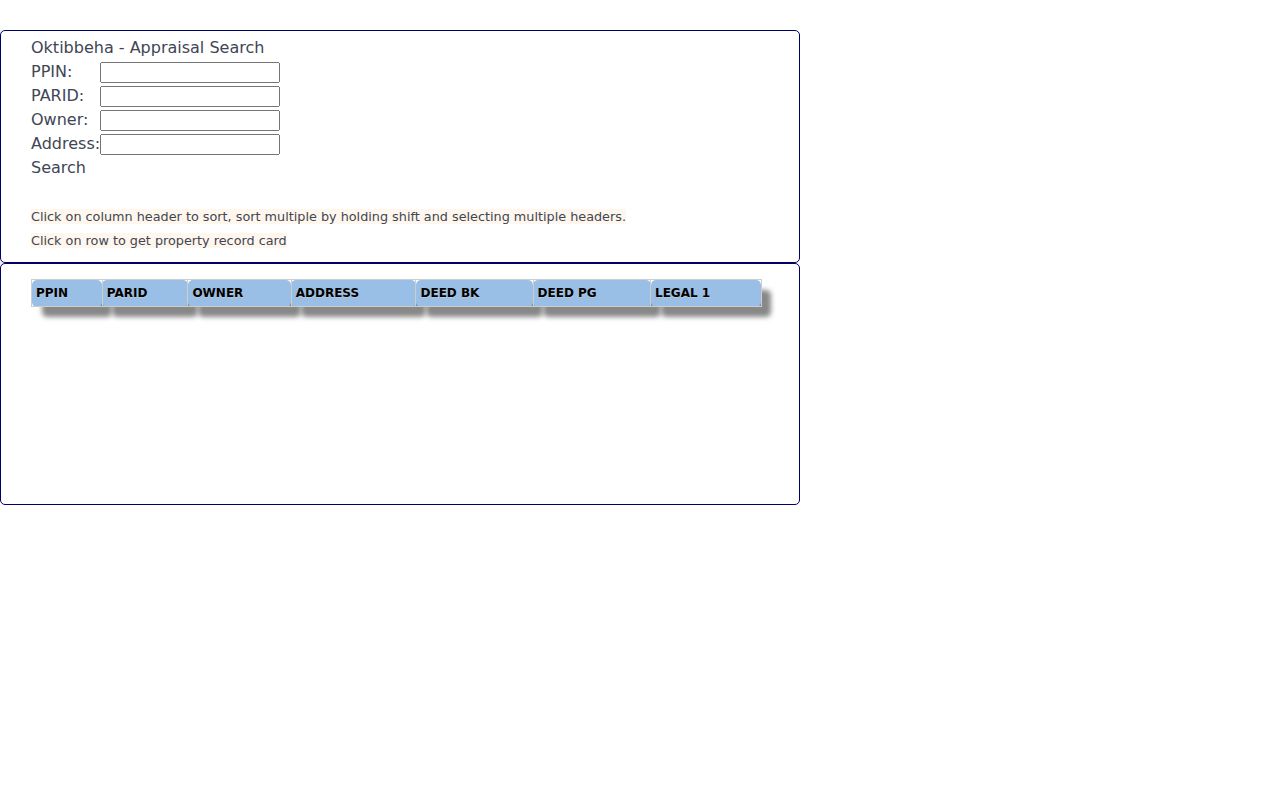
Owner and address searches sit beside stronger parcel keys.
Confirm the Current Oktibbeha Owner
A present-tense answer needs two dates. The card carries a tax year or print date. The deed index supplies a recording date. Oktibbeha County states that a deed filed by December 31 appears on the following land roll. So the name on a just-recorded deed can outrun the current owner shown on the roll.
- Open the parcel card and copy the owner name, PPIN, PARID, legal description, deed reference, and print date.
- Use the Chancery land index to find the newest deed that matches the parcel and legal description.
- Compare the recorded grantee with the roll. Treat the newer deed as the stronger current signal when the roll lags.
- State the result with both sources and the date checked. Note any spelling, entity, or legal-description mismatch.
- Owner of record
- The party named on the assessment roll.
- Assessment roll
- The county's tax-year list of parcels, owners, and values.
- Situs address
- The location of the land, distinct from owner mail.
- Recording lag
- The time between a filed transfer and its appearance on another county system.
Why Oktibbeha Owner Names Lag
Oktibbeha County collects property taxes one year in arrears. That timing, plus the next-roll rule for year-end deeds, explains why a seller's name or address can persist after closing. Treat the mismatch as a deed-check trigger, not as proof the sale failed.
Corrections and annual assessment review can change a card as well. Save the tax year and print date. A bare screenshot without those details becomes hard to reproduce after the roll changes.
Current-record rule. The roll can lag a recent sale. When the parcel and legal description match, the newest recorded deed is the more current ownership signal.
Decode Oktibbeha Entity Ownership
A current owner may be listed as an LLC, trust, estate, or several parties, so copy the label as shown, ET AL and ET UX included. The entity holds record title. Swapping in a person's name distorts the record.
The Mississippi Business Services portal offers organization, individual, non-standard, and file-number searches. It separates similar LLC names. It also identifies filing contacts, though the context never overrides the deed or proves beneficial ownership.
Use the Deed Reference
The deed book, page, and date on a property card bridge tax administration to the recorded transfer. Search those details first. If that deed is not the latest filing, search the same grantee and legal description for a later correction, assignment, or transfer.
The online land index is convenient but informational. The courthouse index is official. Land records run from 1834 to the present. The county does not state the earliest year of web images, so ask the clerk about missing online content rather than calling it a record gap.
Document the Current Owner
A useful current-owner note has layers. It lists the exact owner text, parcel keys, legal description, tax year, print date, newest deed date, and source links. That captures what was known at a moment. It separates the current owner from prior owners.
For anything the web index leaves open, the Chancery Clerk offers courthouse inspection and mail copies. The office is at 101 E. Main Street, Starkville, and its number is 662-323-5834. Hours run weekdays from 8 a.m. to 5 p.m. A mail request should describe the document, include payment, and carry a stamped self-addressed envelope.
Check Protected Oktibbeha Addresses
Mississippi's Address Confidentiality Program gives eligible victims of domestic violence, sexual assault, or stalking a substitute mailing address with mail forwarding. It does not erase land title. Public bodies must still protect a confidential location. A substitute address never shows where someone lives. Current owner data supports purchase checks, boundary questions, estate work, and deed-fraud review, so collect only what the property task needs.
Contact an Oktibbeha Property Owner
The roll's mailing address is the official contact clue. It is not proof of residence. Keep the parcel address and the mail address separate, write plainly, and name the land question. A returned letter is a reason to recheck the dated card and deed, not to dig for sensitive personal details.
Lawful use. Public owner information may support legitimate property research. Never use it to stalk, harass, intimidate, or harm a person.