
Fields in Oktibbeha County Property Tax Records
In Oktibbeha County, one office does both jobs. The appraisal card identifies the parcel. Its valuation detail sits there, while the current and historical bill links on the Oktibbeha County Tax Office page report collection status.
| Field | What It Shows | Where |
|---|---|---|
| Land and improvement values | Separate components behind total value | Assessor property card |
| Total and assessed value | Valuation and taxable class calculation | Assessment roll and card |
| Exemption / homestead code | Relief reflected on the parcel record | Assessor card |
| Tax district | District assignment affecting applicable millage | Assessor card and bill |
| Bill and payment status | Amount, year, payment, or delinquency | Collector's tax links |
Assessed value is not a sale price. Mississippi derives it from true value and a statutory class ratio, then applies millage and exemptions to produce the tax. A deed may state its own consideration figure. That number is neither the current appraisal nor the amount due.
Search Oktibbeha Tax Parcels by Four Keys
The Tristate appraisal search is open to the public, with no visible login or fee gate. It accepts four independent keys, and clicking any column heading sorts the result grid.
| Field | Format or use | Result clues |
|---|---|---|
| PPIN | County property identification number | Most direct key when already known |
| PARID | Parcel identifier, such as 105H-00-075.00 | Connects card and map |
| Owner | Person or entity name | Try surname and company variants |
| Address | Situs text | Start with the property's physical address |
The grid lists PPIN, PARID, owner, address, deed book, deed page, and the first line of the legal description. Clicking a row opens the property card. The assessor search screen shows all four keys together.
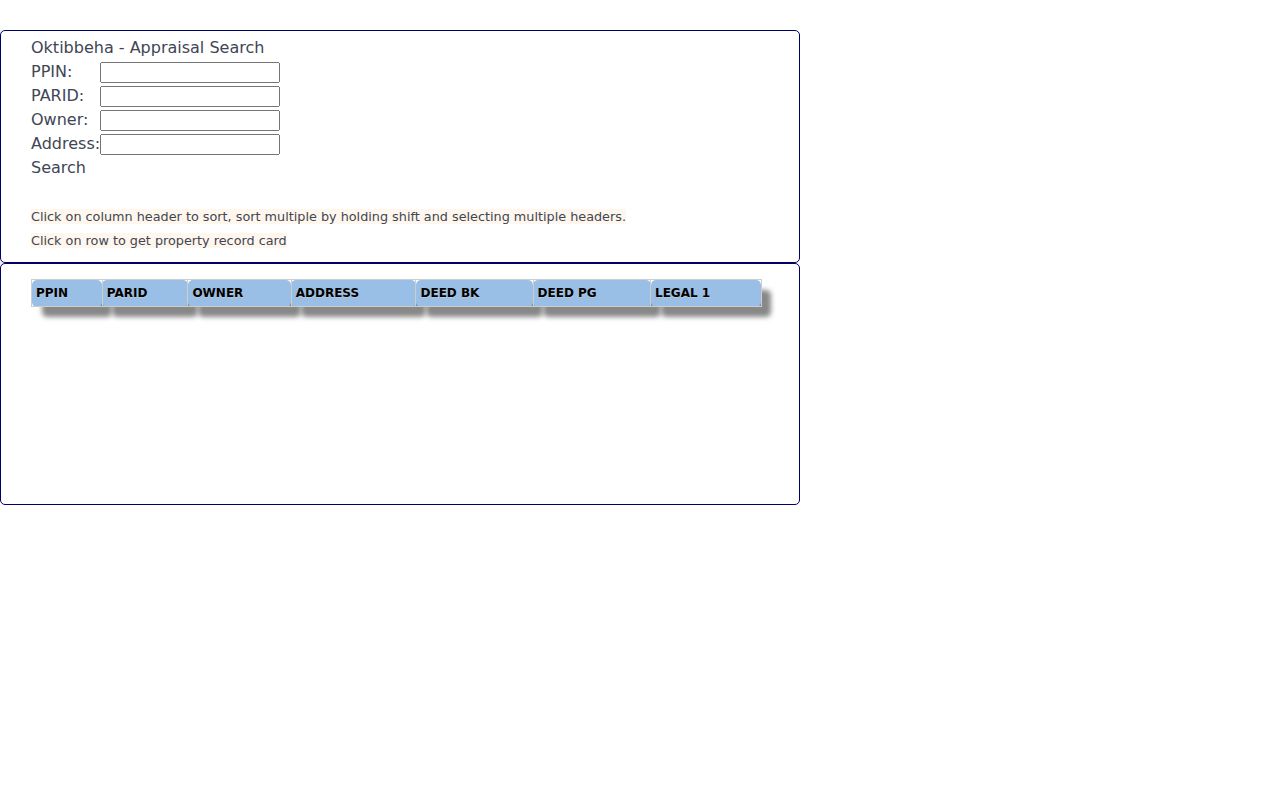
Copy both identifiers first. Then no similarly named owner or address gets confused when you move on to bill, map, or deed sources.
How Mississippi Ratios Shape Oktibbeha Property Tax
Mississippi sorts property into classes. Per the Mississippi Department of Revenue, owner-occupied single-family homes are Class I, assessed at 10 percent of true value. Other real property is Class II at 15 percent. Personal property is generally Class III at 15 percent, public utility property Class IV at 30 percent, and motor vehicles Class V at 30 percent.
- True value
- The appraisal basis before the class ratio.
- Assessed value
- True value multiplied by the statutory ratio for its class.
- Millage
- The rate applied to assessed value by applicable taxing authorities.
- Homestead exemption
- Qualifying relief reflected through the assessor's process.
- Tax lien
- A claim arising from unpaid property tax, distinct from the annual valuation.
The math is short. True value × assessment ratio × millage, adjusted for any eligible exemptions, yields the tax, and county, school, and, where applicable, city rates all shape the bill.
Look Up an Oktibbeha County Tax Bill
Find the parcel first. Then follow the current or historical real-property tax links on the county effective-year page, keeping assessment evidence and payment evidence in separate piles.
- Search the address, PPIN, PARID, or owner and open the matching appraisal card.
- Record the tax year, printed date, district, values, and homestead or exemption codes.
- Open the matching tax-year bill and read payment or delinquency status independently.
- Compare the legal description and parcel identifier across both sources.
- If delinquent, check the current Tax Office notice, sale list, and redemption record.
- Tax year
- The period to which the bill or roll applies.
- Payment status
- The collector's current record of amounts paid or outstanding.
- Tax district
- The combination of jurisdictions attached to the parcel.
- Deed reference
- A book/page clue on the card, not a payment record.
Why Oktibbeha's Tax Roll Can Show a Prior Owner
County FAQ rules drive the lag. A deed must be filed by December 31 of the preceding year for the new owner to appear on the following land roll. Taxes are also paid one year in arrears. So a recent transfer can leave a former owner's name or mailing address in property tax records for a full cycle. That does not mean the prior owner kept title.
For a recent sale, go deeper. Compare the roll with the newest deed in the county deed records. Keep the card's print date and tax year. Those details let you explain any apparent conflict rather than silently trusting one screen.
Note: The taxpayer or mailing recipient on a bill is not automatically the current deed grantee.
Oktibbeha Due Dates, Installments, and Delinquency
Taxes are due February 1. The county's Land Taxes page lists an installment route. One-half is due before February 1, with one-quarter by May 1 and one-quarter by July 1. Confirm the current year's instructions and accepted payment methods before acting, because an old page or receipt may not reflect a later balance.
If the account goes delinquent, record the year, PPIN/PARID, owner shown, legal description, amount, sale status, and correction date. Delinquency can be cured. That service charge is not county tax revenue.
Read Oktibbeha Tax-Sale Records as a Timeline
Unpaid property is offered at the county's annual sale. County guidance allows two years from the sale for redemption before the tax-deed process begins. The official 2025 flyer used an online GovEase auction, with registration opening July 29 for an August 25 sale. Those dates document 2025 only, not a 2026 calendar.
| Stage | Record to retain | What it does not prove |
|---|---|---|
| Delinquent list | Tax year, parcel, list date, status | That the balance remains unpaid today |
| Auction listing | Sale date and offered parcel | Immediate ownership by a bidder |
| Redemption | Payment and release chronology | A conveyance occurred |
| Tax deed | Recorded instrument and legal description | Clear title without further review |
Sale is not immediate ownership. Use the current Tax Office notice, check the two-year redemption chronology, and confirm any later tax deed with the Chancery Clerk.
Homestead and Improvement Changes on Oktibbeha Records
An assessor card can show land value, improvement value, total value, exemption code, and homestead code. Treat a code as a prompt. Ask the Tax Assessor what was approved for that tax year. The roll moves without sales too. New construction, demolition, splits, and corrections all alter it.
State guidance requires revaluation at least once every four years. Oktibbeha's public page shows a 2025 effective year. Board of Equalization materials for 2026 show annual review and correction activity continuing, so date every comparison.
Counter and Mail Access to Oktibbeha Tax Records
Need a card or an old bill that is not online? Go in person or write. The Tax Assessor/Collector sits at 101 E. Main Street, Suite 103, Starkville, and keeps weekday hours from 8 a.m. to 5 p.m. The assessor line is 662-323-8131, and the collector line is 662-323-1273. Have a PPIN, PARID, address, and tax year ready when you call. Staff need those details to pull a parcel or a historical tax bill from the rolls. The office also takes courthouse visits and mail requests under its current instructions. A phone call first can save a trip.
For older assessment context, the MDAH Oktibbeha digital archive is a good stop. The MDAH Oktibbeha digital archive holds historic tax and land series going back to the 1830s. Treat those entries as historical evidence only. They do not replace the current Oktibbeha County tax roll for today's questions.
Contest an Oktibbeha County Assessment
Before you contact the assessor, compare the parcel card against the deed records. Check the legal description, classification, land and improvement values, and exemption coding. Look at similar parcels too. A mismatch anywhere is worth raising.
Ask the assessor for the current review calendar and the notice date. Find out the required filing method and the Board of Equalization schedule. The county publishes no stable public appeal form and no fixed deadline. So confirm both with the office before you file.
Verify the appeal window. Contact the Oktibbeha County Tax Assessor for the current deadline and filing instructions before relying on a prior agenda or notice.