
Trace Former Oktibbeha Property Owners
Work backward from a deed reference you can actually verify. A downloaded list of names is not a chain. Treat each row as one transfer. Record only what the recorded instrument or an official index states. The legal description then tests whether consecutive Oktibbeha County deeds cover the same tract.
| Transfer Date | Grantor to Grantee | Deed Type | Book/Page |
|---|---|---|---|
| Newest recorded transfer | Seller to current grantee | As indexed | From card or index |
| Earlier acquisition | Prior grantor to that seller | As recorded | Follow reverse index |
| Next earlier link | Earlier owner to prior grantee | As recorded | Match legal description |
| Historic-book link | Book parties as written | Warranty, quitclaim, or other | Courthouse book/page |
The DuProcess land index gives you grantor, grantee, instrument, date, volume, and book and page for recorded deeds. It is the official Chancery index. Party, date, and volume fields build the backward chain. Pull the instrument itself whenever a name or legal description fails to match the tract, since an index line alone cannot settle a conflict. The official online inquiry screen displays those very fields.
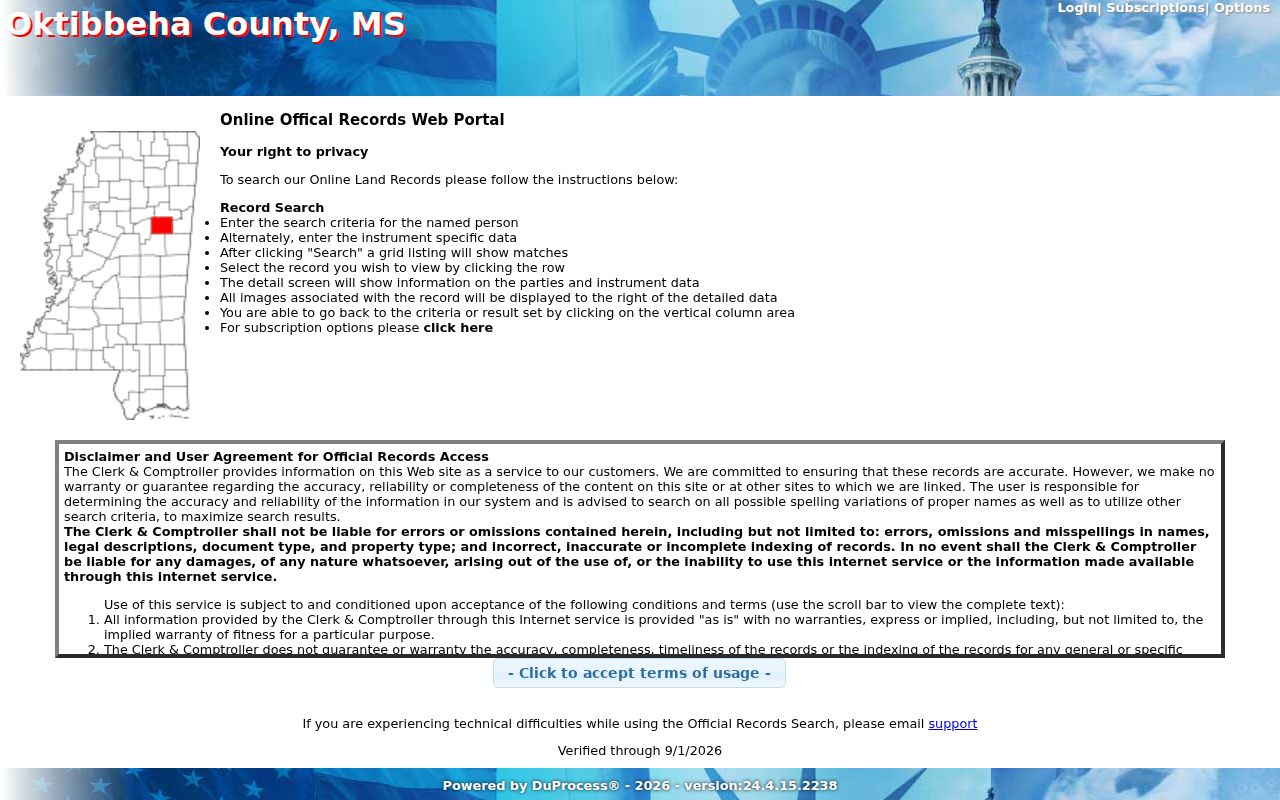
Those controls do the walking. Book and page references make every link in the Oktibbeha County deed chain easy to retrace and check again.
Reconstruct Oktibbeha Ownership Backward
Start from the deed reference printed on the assessor card. Its grantor is your candidate prior owner. Move that grantor's name into the grantee field and search earlier dates, repeating the step only when the parcel facts still match the tract you are following.
- Find the newest acquisition deed with the current owner as grantee. Copy its date, parties, type, and book/page.
- Read the grantor as the candidate former owner. Confirm that the legal description matches the subject land.
- Search that person or entity as a grantee at an earlier date, trying initials, spelling variants, ET AL, and ET UX where relevant.
- Repeat the match. If an image is missing online, continue with the courthouse book, microfilm, or archive inventory.
- Grantor
- The party transferring an interest.
- Grantee
- The party receiving the interest.
- Chain of title
- The linked sequence of instruments affecting the same land.
- Reverse index
- An index organized to find earlier acquisitions through a party name.
- Quitclaim and warranty deed
- Different deed forms whose legal effect must be read from the instrument.
Reach Earlier Oktibbeha Deed Books
Oktibbeha County land records reach back to 1834. The online inquiry form does not state how early its index or images go. A missing image is an access limit, not a lost deed. The county Record Vault holds deeds from 1834 onward along with subdivisions, mortgages, liens, lis pendens, UCC books, wills, and court minutes. Much of it is only at the courthouse.
The Chancery Clerk's office at 101 E. Main Street in Starkville opens weekdays from 8 a.m. to 5 p.m. Mail requests work too. Include a clear description, payment, and a stamped self-addressed envelope. Self-made copies cost $0.25 per page. Staff copies cost $0.50 per page, plus certification when requested.
Online limit. No verified web cutoff year was published. Older former owners may require courthouse deed books, microfilm, or archival copies.
Match Oktibbeha Legal Descriptions
Older Oktibbeha County deeds describe land by subdivision lot and block. Some use section-township-range, and some use metes and bounds. None rely on a modern street address. Compare the description at every step of the chain. A shared surname proves nothing. A reserved strip or small exception may mean an instrument covers only part of today's parcel.
Plats bridge the gaps when land was split or assembled. Starkville examples include College Addition, Longmeadow phases recorded in 1958, 1960, and 1963, and Southdale platted in 1960. Treat those dates as search leads rather than a finished title history. The recorded plat and the deeds themselves control.
Bridge Old Oktibbeha Addresses
An old address can stop matching. Anchor the search in the current PPIN, PARID, deed reference, and legal description instead. Plats add context too. The Starkville-Oktibbeha County Public Library's local-history annex holds telephone directories, newspapers on microfilm, annuals, and primary documents that can suggest when a house was occupied or when a street name came into use.
Those findings never transfer title. Context is not ownership. Record them in a separate column so they never harden into false links in the Oktibbeha County deed chain.
Use Mississippi Archives for Owners
The MDAH Oktibbeha digital series includes tax and land material beginning in the 1830s, and MDAH also maintains county microfilm plus a pre-1920 inventory. Series 2050 identifies original records. Those include deeds from 1838 and 1844 and tax-sale or redemption records from 1849.
Archives repay a known courthouse citation. Search by county, office, series, date, volume, and names. A tax roll can hint at year-by-year ownership. It cannot replace a recorded deed.
Handle Estate Transfer Gaps
Sale-to-sale chains break at estates. Land can pass through a will, a court order, a trustee, or a crowd of heirs instead. The Oktibbeha Chancery Clerk holds probate, wills, and related Chancery material alongside the deed records. Search the estate, executor, and heirs. Then look for a later deed that gathered or conveyed the scattered interests.
The assessment roll misses intermediate rights. Do not assume otherwise. Probate orders and later deeds may explain why a grantor never appeared as the sole prior owner on an older Oktibbeha County card.
How Far Oktibbeha Owners Reach
Oktibbeha County's land records start in 1834. Online access may reach less far. Distinguish the public index, the available image, the courthouse book, and the archival copy in every search. That precision beats claiming all deeds are online. A blank screen is not the end.
Former-owner research feeds house history, estate work, boundary review, and purchase diligence. State your final confirmed owner, your earliest confirmed link, and each break that resists explanation. When legal rights depend on the result, order a professional title search.
Lawful use. Trace former owners for legitimate land and history work. Never use historical records to track, harass, or harm a living person.